Empowering the Night Shift: The Circadian Home™
Thank you for stopping by my WE CARE Nursing Conference poster. The Circadian Home™ is a nurse-led educational framework exploring practical ways to work with circadian biology during night shift. I’m continuing to refine this work, and I appreciate your interest.
The Poster at a Glance
A Nurse-Led Framework for Circadian Alignment
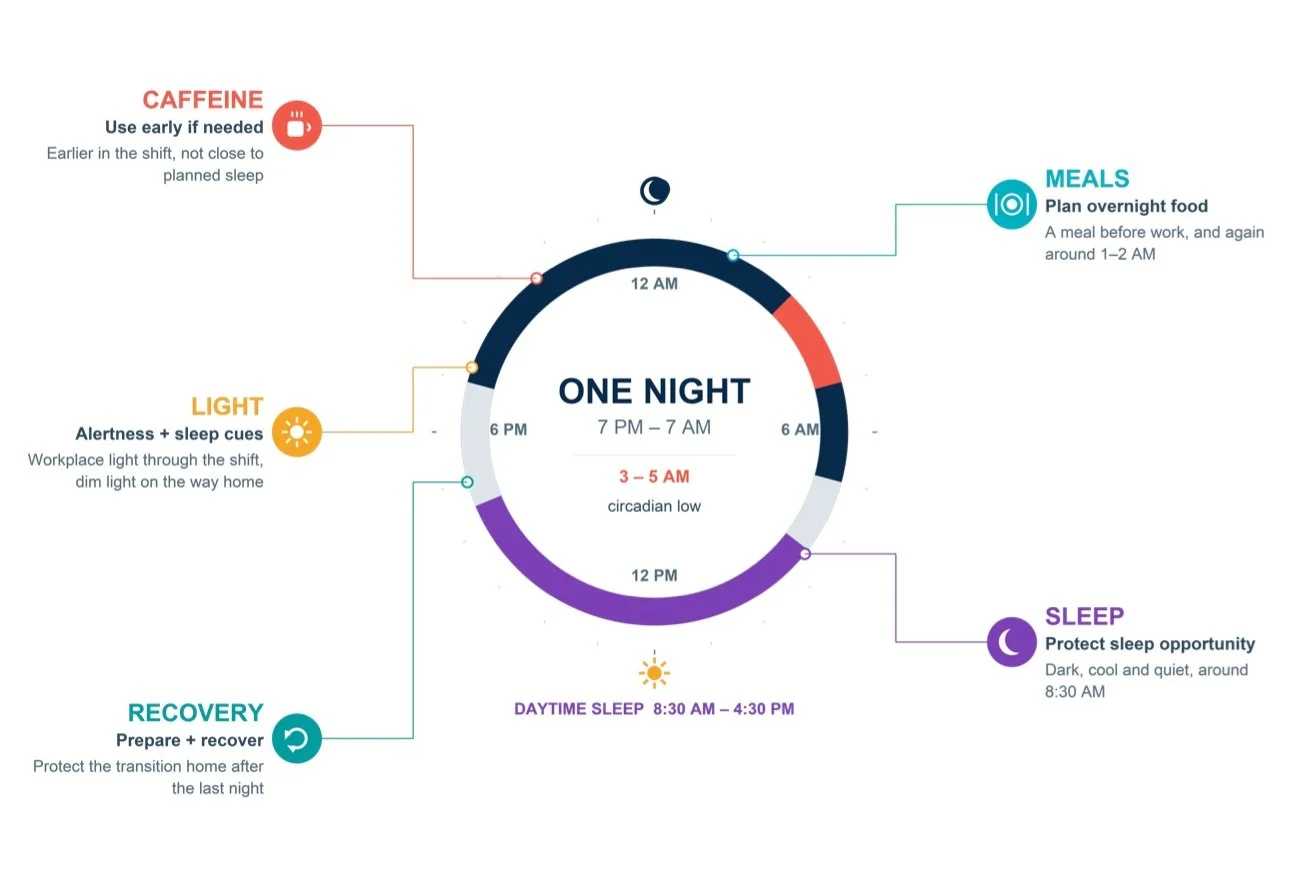
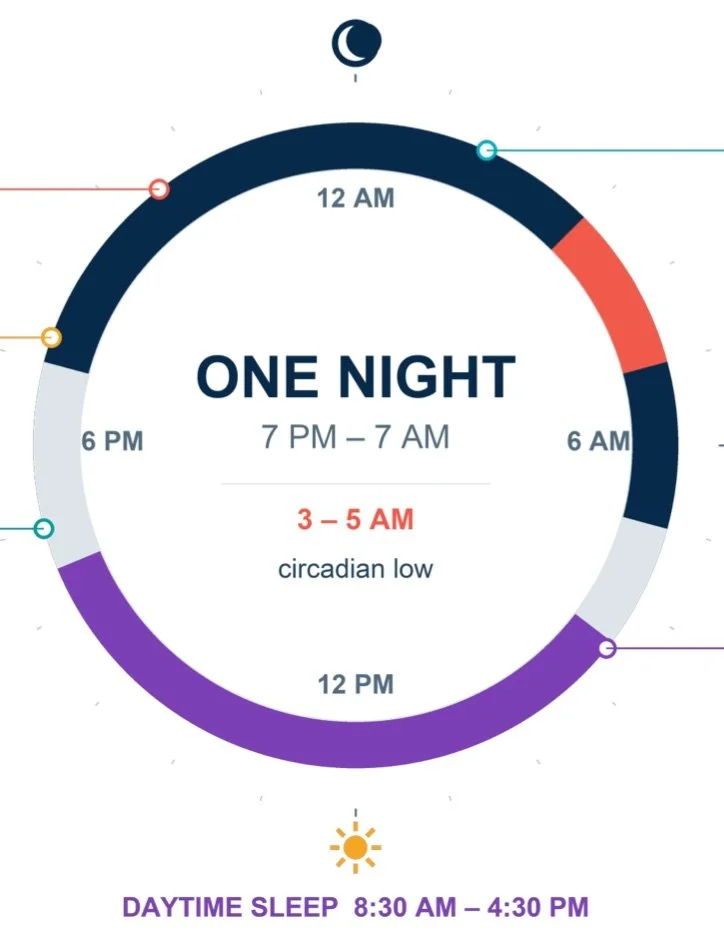
The Circadian Home Framework · Five Practical Levers Across One Night
1 · Background / Purpose
My mother was an LPN who also worked nights. She developed type 2 diabetes at 36 and died of metastatic breast cancer at 49. I cannot say shift work caused her illnesses. However, current research shows that long-term circadian disruption and persistent night-shift work are associated with increased health risks.
I can't change the past, but I can educate the future.
At UAB, night shift workers report more distress and burnout
63%of night shift workers reported distress, compared with 51% on day shift
55%reported burnout, compared with 45% of day shift workers
WE CARE's own evaluation. Survey of 878 UAB Hospital shift workers (ref. 3).
WHO / IARC 2020: night shift work is “probably carcinogenic to humans” (Group 2A).
That is a hazard classification. It does not mean every night worker will get cancer.
2 · Methods / Implementation
I read the research on circadian rhythms and shift work, then put it into plain language nurses can use.
- Built from peer-reviewed research and the World Health Organization report on night shift work.
NEXT STEPS, IF THE PROJECT MOVES FORWARD
- Have night-shift nurses review it, then write it up as a handout and a one-page schedule.
- Ask about their sleep and confidence before and after.
3 · Results / Outcomes / Impact
This project is still in the planning stage, so I do not have outcome data yet. What I hope it does:
- Nurses learn how important sleep is, and how to use what is here
- Nurses sleep better on a night rotation
- Nurses feel more confident moving between nights and days
4 · Conclusions
The research on circadian health is already out there. It just has not been turned into something nurses can use.
Shift work is essential to healthcare, but nurses deserve education that helps them work with their biology instead of against it.
Shift work is necessary. The biological cost nurses pay is not.
See the Full Poster
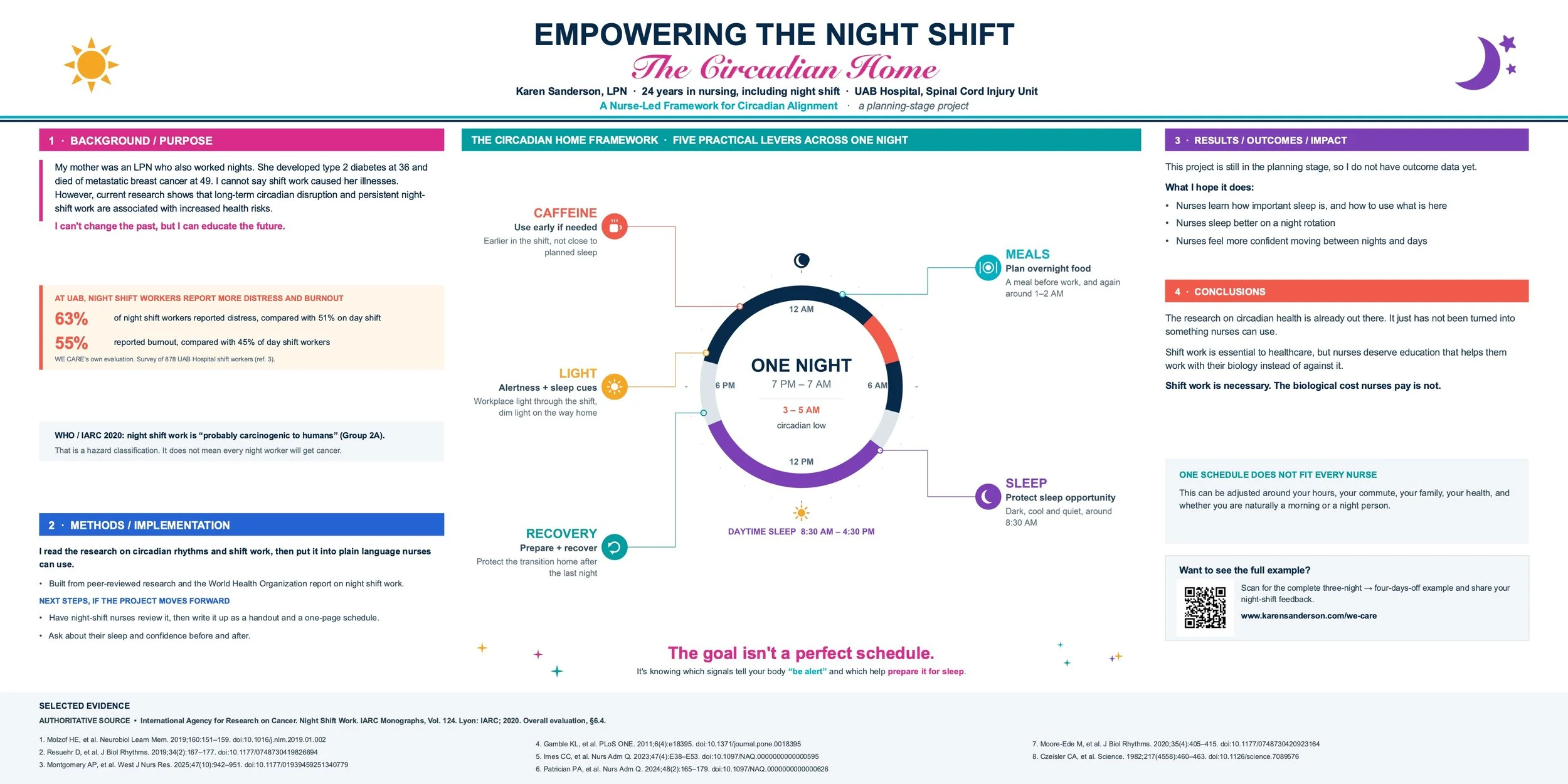
Tap or click the poster to open it full size. On a phone, pinch to zoom.
Selected evidence (references)
Authoritative source: International Agency for Research on Cancer. Night Shift Work. IARC Monographs, Vol. 124. Lyon: IARC; 2020. Overall evaluation, §6.4.
- Molzof HE, et al. Neurobiol Learn Mem. 2019;160:151–159. doi:10.1016/j.nlm.2019.01.002
- Resuehr D, et al. J Biol Rhythms. 2019;34(2):167–177. doi:10.1177/0748730419826694
- Montgomery AP, et al. West J Nurs Res. 2025;47(10):942–951. doi:10.1177/01939459251340779
- Gamble KL, et al. PLoS ONE. 2011;6(4):e18395. doi:10.1371/journal.pone.0018395
- Imes CC, et al. Nurs Adm Q. 2023;47(4):E38–E53. doi:10.1097/NAQ.0000000000000595
- Patrician PA, et al. Nurs Adm Q. 2024;48(2):165–179. doi:10.1097/NAQ.0000000000000626
- Moore-Ede M, et al. J Biol Rhythms. 2020;35(4):405–415. doi:10.1177/0748730420923164
- Czeisler CA, et al. Science. 1982;217(4558):460–463. doi:10.1126/science.7089576
A Night-to-Day Example
Three 12-Hour Night Shifts → Four Days Off
PREPARE
Getting Ready for Night 1
Wake normally → Morning daylight → Hydrate → Breakfast
Balanced lunch
Protected nap opportunity
Wake → Brighter light → Hydrate → Get moving
Balanced pre-shift meal
PERFORM
During the Night Shift
Light + activity → Hydrate → Caffeine early in the shift if used
Planned snack if hungry
Example caffeine cutoff if planning to sleep around 8:30–9 AM. Individual caffeine response varies.
Smaller overnight meal rather than making the middle of the biological night the largest meal of the day
Circadian low: movement → hydration → light → activity as work conditions allow
PROTECT
Transitioning Home
Shift ends → Begin reducing unnecessary bright-light exposure if preparing for daytime sleep
Home → Small snack if needed → Lower lights → Begin a predictable wind-down routine
SLEEP
Around 8:30–9 AM
RECOVER
Between Nights 1–3
RESET
After Night 3: Returning to Days
Final shift ends
Shorter recovery sleep
Wake → Daylight → Hydrate → Eat → Daytime activity
Avoid late caffeine → Avoid another long nap when possible
Lower evening light → Reduce stimulating activities and screens → Prepare for sleep
Return toward nighttime sleep
One schedule does not fit every nurse. Circadian education can be individualized around work hours, commute, family responsibilities, sleep needs, chronotype, health considerations, and what is realistically sustainable.
A nurse-centered wellness approach considers the individual behind the schedule and helps identify realistic strategies that fit that nurse's life and needs.
Help Shape Future Resources
If you work nights—or have worked nights—I'd love to know what would be most useful to you. Your feedback will help guide future educational resources.
No name or email is required. Your feedback will help guide future night-shift educational resources.